
From Brexit to the House of Lords: Insights from Lord Frost
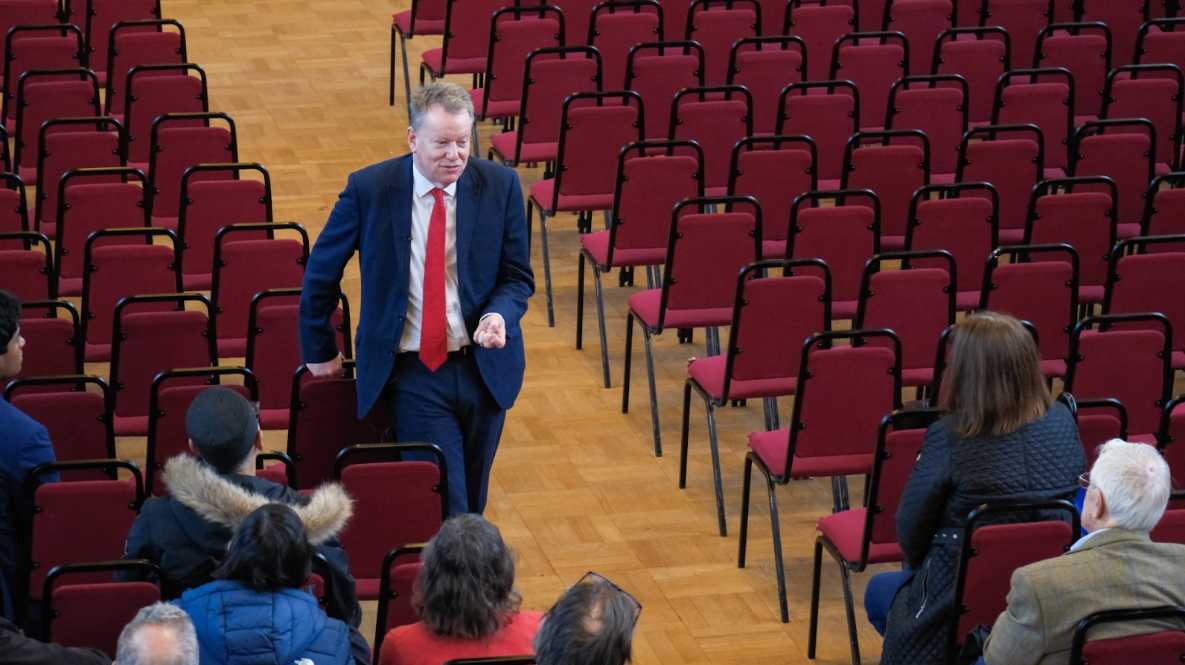
On the 28th of November, Lord Frost returned to Nottingham High School, 42 years after attending as a student. Throughout the day, he delivered talks and took part in q&a sessions, discussing his political beliefs and experiences.
Lord Frost is a British diplomat and politician, best known for leading the UK’s negotiations with the European Union after Brexit. He served as Minister of State at the Cabinet Office in Boris Johnson’s government, and is a strong opponent to the Assisted Dying Bill in the House of Lords. Recently starting his role as Director of the Institute of Economic Affairs, Lord Frost advocates for free market measures.
This article reports on the views expressed by Lord Frost during his visit and does not seek to endorse any particular political opinion.
‘What areas do you think the government should be involved in?’
In response to Lord Frosts’ question, Sixth Form Students suggested areas ranging from defence to healthcare. Lord Frost outlined his view that the role of the government should be limited, arguing that high government spending, taxation, and regulation has negative effects on the economy.
He referred to Frederic Bastiat’s Broken Window Fallacy, which argues that destruction does not benefit the economy (even if it creates work through repairs) because it diverts money from other possible uses. Lord Frost applied this idea to government policy, suggesting that while the effects of public spending and intervention are visible, the economic activity that may have occurred with lower taxation is harder to see, and therefore may be overlooked.
‘Brexit was one of the most controversial episodes in recent British history. How did it feel to be a face of controversy?’
Lord Frost responded that ‘it was a real shock.’ He noted that it was difficult to see himself frequently in news coverage, and that he felt a crushing sense of responsibility to quickly reach a deal with the European Union.
Reflecting on the outcome of Brexit, Lord Frost said ‘We did do it, perhaps not perfectly, but we did it.’ When asked whether Brexit had delivered what he had hoped, he rated it an ‘8/10’, saying that the Conservative Government achieved most of its objectives. He identified the Northern Ireland deal as the main weakness of Brexit, whereby it remained within the EU single market. When questioned on figures claiming Brexit has lowered UK GDP by 4%, Lord Frost called it ‘a complete fantasy figure’.
Describing his time working for Boris Johnson, Lord Frost said ‘I loved working with Boris. He had this amazing ability to strike up a relationship with anybody. He is a very likeable person.’
Assisted Dying Bill
When asked about his views on the Assisted Dying Bill, Lord Frost said ‘I am strongly against it.’ He explained that his opposition was based on concerns that the eligibility criteria could be widened over time. Comparing his stance on this to his opposition to the death penalty, he stated that his views were influenced by Judeo-Christian moral principles.
Conclusions
Lord Frost’s visit offered students the opportunity to hear directly from a senior political figure involved in some of the most significant policy debates of recent years. The sessions provided insight into how political decisions are shaped by economic theory, personal values, and the practical challenges of leadership.

Comments ()