
The Broken Council Tax System: Is a Mansion Tax the Solution?

Amith Mayakonda
People in the North pay twice as much Council Tax as those in the South.
Council tax is needed for shared public services, such as road maintenance, picking up bins, libraries and social care. Back in 1991, the government assigned houses to bands based on their valuation, with Band A being the cheapest properties and Band H for the highest value properties. Higher bands pay a larger amount of tax. Different councils set different baselines of council tax depending on their demand.
What surprised me most is the sheer difference in council tax between the North East and London.

This massive disparity is quite alarming, not only due to the sheer amplitude of this difference but also because people up north tend to be less wealthy, and the fact that they have to pay a higher council tax bill feels unfair.
One of the reasons for this difference is business rates. Councils like Westminster are packed with global corporate offices, high-end hotels, and lots of major shopping districts like Oxford Street, whereas the North East generally has fewer businesses. More firms mean that the council receives more revenue from business rates, and because these councils make so much money from these commercial businesses, they don’t need to rely heavily on residents to fund local services.
Another reason is that the majority of properties in the North East have low values compared to London in 1991 and therefore sit in the lowest bands (A and B). To raise enough overall budget to pay the bill, northern councils are forced to set a high rate for every band to make up the difference.
The Mansion Tax
The mansion tax is an annual recurring surcharge for homes in England worth around 2 million pounds or more collected alongside council tax. This was announced in the Autumn 2025 budget and will come into effect in April 2028. It is expected to impact less than 1% of homes in the UK.
There are four price bands with the surcharge:
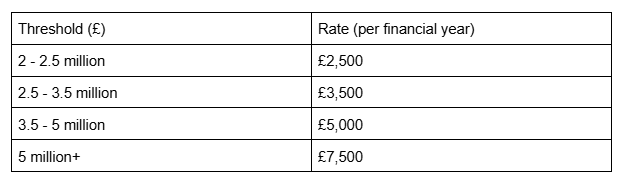
The mansion tax would help fix this problem by breaking the 1991 rules. The system currently has a “ceiling” at Band H, so if a London mansion is worth £1 million or £100 million, its council tax is strictly capped at the exact same rate. Since these southern councils set very low rates, millionaires pay next to nothing. The mansion tax would therefore make sure everyone contributes more fairly. Furthermore, instead of this money going back into the already wealthy London councils, it goes back into the government who could choose to then distribute the money to poorer northern councils, preventing an increase in the local tax rates.
However, it does have its problems. This penalises “asset-rich, cash-poor” homeowners, like pensioners who bought their homes decades ago and may lack the funds to pay such high taxes.
Additionally, this would call for many houses to be revalued using a computer algorithm. This automatically estimates your home’s modern value by comparing with Land Registry sale prices. The problem with these £2 million houses is that there are few comparable houses nearby as they tend to be very spacious and unique, which causes many disputes over the valuation.
Another problem is that houses just over the £2 million mark are now priced at £1.95 million to attract buyers, as they refuse to inherit a £2,500 annual tax bill. This creates a significant pile-up of properties listed at identical prices right under the line, causing the luxury housing market to freeze. This would therefore lead to a massive drop in Stamp Duty revenue, which can cancel out the money they hoped to raise from the mansion tax.
So is the mansion tax the solution?
No, not really. It is rather a temporary bandage than an actual repair. The real problem is that council tax bands are based on 1991 valuations, which is why a £100,000 flat in Newcastle and a £3 million house in Westminster can pay similar rates, forcing poorer councils to charge more to cover their own expenses. A £2 million surcharge collected centrally doesn’t counter the underlying unfairness, it instead adds a new tax on top of an already outdated one. Its main benefit is breaking the artificial “ceiling” that lets London’s wealthiest properties easily survive on rates set for a cheaper housing market, but it risks catching “asset-rich, cash-poor” homeowners who don’t fit the mansion tax stereotype. A proper solution would mean revaluing every property in the country and rebuilding the bands from scratch - until a government is willing to do that, the mansion tax simply acts as a plaster.
Comments ()